NHL Back in Kansas City: Target #3: Ottawa Senators

The third team on the list of targets for a move is the Ottawa Senators. Their attendance numbers last season put them at the bottom of the league averaging 9,155 fans, which put them at 47.8% capacity. The Senators have been the center of scrutiny while being owned by Eugene Melynk. Upon his death in March, the team was left to his daughters. While in most cases this would stir up speculation, this seems to have had the opposite effect. Most of that can be contributed to the drama and antics swirling around Melnyk the last few years of his life, from rumors of employee abuse to threats to move the team to legal issues abound.

Let’s discuss the rocky history of the team. The modern-day version of the Senators was the idea of Bruce Firestone in 1988. After campaigning two years, he was awarded a franchise on December 6, 1990 to begin play for the 92-93 season. The team played in the Ottawa Civic Center, while they worked on the development of the new arena. During that process, that included getting rural land rezoned, Firestone had to bow out. Rod Bryden took over ownership in 1993.

After playing the first few seasons at the Civic Center, the Senators finally got to play in the new home on January 17, 1996. What was first known as The Palladium became the Corel Centre one month later. It’d later be named Scotiabank Place, then Canadian Tire Centre. The arena would plague the team with debt, as well as scrutiny for being so far from the city. The debt that Bryden incurred led to a bankruptcy filing on January 9, 2003.

In 2003, Canadian businessman and philanthropist Eugene Melnyk bought the team and arena. At the time, he was seen as the savior, vowing to keep the team in Ottawa. Things went good under his ownership, the team went to the Stanley Cup Finals in 2007. Then, things started to go bad. In 2017, he began threats to move the team if he didn’t see more support. In September 2018, he released a video with plans for a team rebuild, where he referred to the team as being “in the dumps”, which got him criticism. That saw the beginning of the push from fans for him to sell. He had no intention of selling. The 2018-19 season saw the franchise record for empty seats drop to a 22 year low, with the average attendance trending down since 2012-13. In 2019, the New York Post called the Senators the laughingstock of the NHL because of debt, lawsuits, and drama surrounding Melnyk. Part of the lawsuits and drama was tied to Melnyk’s desire to build a new arena Senators in a project known as LeBreton Flats. A project that fell apart for him when the relationship between him and John Ruddy turned sour.

Melnyk died March 28, 2022. Immediately questions arose about the future of the team. NHL Commissioner Gary Bettman told reporters team was left to Melnyk’s daughters, Anna and Olivia, saying it was “completely stable and functioning in the ordinary course.” May 4, 2022 saw a report there were parties interested in purchasing the team. One of those was Quebecor, which would be looking to purchase it to move to Quebec. The other was John Ruddy, who was previously a partner of Melnyk’s in the exploration of the LeBreton Flats project.

June 23, 2022 saw the announcement the Senators had won a bid to build a new arena at LeBreton Flats. Populous Design (KC company) has been named as the design team. With that, it seems almost certain the team’s future in Ottawa is secure and John Ruddy probably has the inside track on purchasing the team if it were to be sold anytime soon. But a dark horse could always come in and throw a monkey wrench into plans, it’s been known to happen.
Upper Deck Making It Up

I blasted Upper Deck for their O-Pee-Chee redemption card error back in March. There was no excuse for not honoring the card, even if it was an error. Their response to my inquiry was lacking good customer service. All of that at a time when they were putting out inferior products with many reporting damaged cards in brand new unopened packs of last season’s UD series products. This led me to be less than enthusiastic about ordering new products, even though I was anxious to get my hands on Young Guns of Cole Caufield and Trevor Zegras. While 2021-22 Series 1 still had quality issues and pack mistakes, it seemed like improvement was coming. Series 2 seemed a bit better, but some were still seeing issues in quality. And let’s not forget the price hikes that most of their products have had.

Now, with UD’s release of Extended Series, it feels like they are correcting the problems and starting to make it up to the fans. This newest set wasn’t terribly exciting at first, but I’m a completist, well at least when it comes to the base, so I want every base. I needed a Marc-Andre Fleury in a Blackhawks jersey and Seattle Kraken players in Kraken gear. I got that and more. The new series had wonderful Kraken cards, some even designated Inaugural game. There were also great inserts from Trilogy, throwback Black Diamond, and SPx—so many of them numbered. And while I wasn’t incredibly thrilled with the crop of Young Guns that would be featured (no big chase card), the retro Young Guns were worth it. They were great and offered you the opportunity to pull an alternate version of a Young Gun that was featured in one of the previous series of the season. Including canvas cards in extended was also a wise choice, especially with the addition of mascots. I will be buying more if my pocketbook allows because I wasn’t lucky enough to snag a box with one of those mascots or the Young Guns Canvas of Michael Bunting, yet.

So, thank you Upper Deck for giving fans their moneys worth this time. Now, if those prices weren’t so darn high.

NHL Back in Kansas City: Target #2: Calgary Flames

First off, I want to say I’m not going through the teams in any kind of order. And now on to the second team, it might be a shock to some, but the Calgary Flames are on the list. They only averaged 74.1% of capacity this past season (not sure if Canadian COVID regulations were taken into consideration for part of the 2021-22 season when calculating capacity). Of the teams I’m covering in this series, they had the highest percentage of capacity. But, even if the Flames are drawing well and putting a quality product on the ice, there are arena issues. They’ve been looking to get a new home built since 2017 and have had unsuccessful negotiations with the city. Deals have been struck on a couple of occasions, only to be backed out of. Could the Flames be looking for something better than what Calgary has to offer them?

Let’s start off with the history of the organization. The franchise was originally the Atlanta Flames. They started play in 1972, the team was quickly put in place to balance the NHL when they added the New York Islanders franchise to keep the WHA out of the brand-new Nassau Coliseum. The Flames were owned by a group that owned the NBA’s Atlanta Hawks, led by real estate developer Tom Cousins. They played in Atlanta’s Omni Coliseum for eight seasons. Eventually Cousins was forced to sell the team to stave off bankruptcy. Former Edmonton Oilers owner Nelson Skalbania and a group of Calgary oil magnates purchased the team for $16 million. They announced on May 21, 1980, they would be moving the team to Calgary, Alberta, Canada. This gave the province of Alberta two NHL teams.

Skalbania sold his interest in 1981. Since then, the Flames have been under complete local ownership. The first three seasons, the team played in the Stampede Corral before moving to the Saddledome in 1983. The Saddledome was not only built to be the home of the Flames, but also to host the 1988 Winter Olympics. The Scotiabank Saddledome is still the home of the Flames, having served in that capacity for almost 40 years. This makes it the second-oldest arena in the NHL after the New York Rangers’ Madison Square Garden. It has been renovated once in 1994. It underwent some repairs due to flooding in 2013.

The team has expressed interest in getting a new arena since 2017. That was when they gave their first proposal to the city, but they eventually threw in the towel. In 2019, the Flames and city had reached an agreement, but it fell apart in 2021. The official termination of that deal happened January 1, 2022. There’s reportedly a $10 million gap between the city and team. In May, it was reported that a group of Calgary businessman was working as a go-between with the city and team in hopes of facilitating a new deal, but nothing has been reported recently.

While it sounds like this team would be ripe for a move, it’s unlikely with the local ownership group the Flames currently have. Calgary Sports and Entertainment Corporation own the WHL Calgary Hitmen, Calgary Stampeders Lacrosse team, Calgary Roughnecks (CFL), and Calgary Wranglers (AHL affiliate of Flames). They also have managed the Saddledome since 1994. With the group’s major local ties, it seems unlikely they would move. Yet, NHL commissioner Gary Bettman has told the media Calgary will not host any NHL events (i.e. Draft, All-Star Game, Awards) unless they get a new building. If ownership and city continue to bicker on building a new arena, it might be possible that ownership gets frustrated enough they decide to sell. Only time will tell what happens with the franchise, but you never know, five years of trying to get a deal done seems like an awful long time for no ground to have been broken, yet.

NHL in Kansas City: Target #1: Arizona Coyotes

NHL jersey and affiliation news has been exciting, but back to the subject at hand. It appears the NHL’s not interested in expanding beyond 32 teams, so let’s look at teams that could be ripe for a new home.

After looking at attendance for the 2021-22 season, I’ve made a list of 5 teams that could be ripe for a change of scenery. These teams all fell under 75% of capacity. Two around 50%. Four have gone public with arena issues.

To keep things concise, I’ll focus on one team each blog. The first team is the ever popular soap opera known as the Arizona Coyotes.

First, let’s start with a rundown of team history. The team started as a WHA team called the Winnipeg Jets in December 1971. In June 1979, the Jets were one of the WHA teams absorbed by the NHL. July 1996 saw the franchise move to Arizona and become the Phoenix Coyotes.

In 2003, the team relocated again, this time a few miles away to Glendale. This would be the beginning of the drama. Jerry Moyes bought the team in 2005, by 2009 he declared bankruptcy. The NHL took over the team, signing a short-term lease with Glendale. In 2010, the league received a bid for the team, but it was derailed by a litigation threat. When the league threatened to move the team in 2013 (they nearly moved to KC), Glendale signed a 15-year lease with the team to support the new ownership effort.

By 2015 with new ownership in place, Glendale voided that lease after alleging a violation of conflict of interest laws. This started the year-by-year lease agreements. In 2016, the team had plans to move to ASU, building an arena there, but the university backed out of the deal.

In July 2019, the Coyotes got a new majority owner in Alex Meruelo. He purchased a 95% stake in the team. The previous owner, Andrew Barroway, maintained a 5% minority stake. Despite the change in ownership, the Coyotes arena troubles continued.

The drama with Glendale, Gila River Arena, and Coyotes heated up as the city and arena got fed up with unpaid bills. They threatened to lock the team out if debts were not paid. The Coyotes dodged that bullet, paying the debts off just in time.

Gila River Arena management had enough of the drama, and gave the Coyotes notice they wouldn’t be welcome back at the conclusion of the 2021-22 season. This began speculation of where the team would move, with cities like Quebec and Houston salivating at the possibility of bringing the NHL home.

The Coyotes settled in on a plan to temporarily share facilities with ASU as they worked on a new arena site in Tempe. The Coyotes will be playing the next 3-4 seasons at ASU, sharing the 5,000 seat arena with the college, assuming they don’t violate the agreement they entered with the college. In the meantime, the Coyotes work to get the green light for land they’re interested in near the airport. The airport and FAA have questioned the plans, not just for the arena but the development that would surround it. It should be noted this is land the Arizona Cardinals had interest in building a stadium on 20 years ago.

So, while the Coyotes don’t look like a winning team with the current roster. The team has a promising future on the ice, somewhere. Where that future ends up is a big question mark, until the Coyotes get an agreement worked out on that land, get the land purchased, and start the digging.

Meanwhile, if they can’t figure things out in the desert, KC could be a perfect landing spot. There’s an NHL caliber arena available with no other regular tenants. There would be no need to realign the league, the team would fit perfectly in the Central Division. Also, with the built-in hockey fan base that exists they certainly would draw more than the paltry 5,000 or even their previous season average of 11,601. Of course, in this case, there’s also Houston.

Mavericks Ready To Get Kraken

Kansas City Mavericks Picture Taken From Twitter

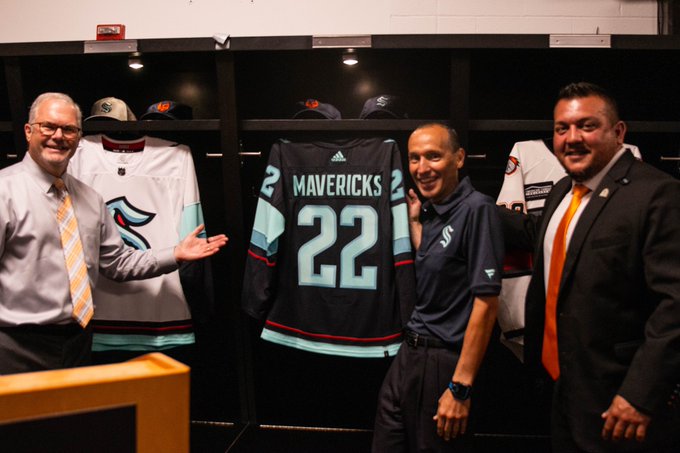
July 28, 2022, starts a new chapter in Mavericks’ history. Today the KC Mavericks announced a new NHL affiliation with the 2nd year Seattle Kraken. This means KC hockey fans will get the opportunity to see potential future Kraken or at least some Coachella Valley Firebirds (Firebirds are the AHL affiliate that KC will be sending and receiving players from).

After looking at Seattle’s roster, they really don’t look like they have the depth to provide KC many players, probably a right winger or two (they have a ton) and they look to have maybe a center to spare. But that’s good news for players the Mavericks have signed. It means Mavericks’ signees will get a look from Kraken and Firebirds staff, and they could get signed to deals with those clubs. Also, there’s the possibility Seattle starts stocking the cupboards this summer, picking up more players for the AHL and ECHL affiliates. If they do, I suggest a few more D and another goalie would be the priorities.

The affiliation probably won’t be a huge difference maker for the product on the ice, as the Mavericks have already signed 10 players on their own this off-season. But this announcement could and should generate excitement and put more butts in the seats at Cable Dahmer Arena this season. It’s time to start the recovery from the attendance drop off caused by the pandemic. It’s time to get cracking (or…Kraken…lol) and get the Mavericks back into the playoffs.

July 28, 2022, starts a new chapter in Mavericks’ history. Today the KC Mavericks announced a new NHL affiliation with the 2nd year Seattle Kraken. This means KC hockey fans will get the opportunity to see  potential future Kraken or at least some Coachella Valley Firebirds (Firebirds are the AHL affiliate that KC will be sending and receiving players from).

After looking at Seattle’s roster, they really don’t look like they have the depth to provide KC many players, probably a right winger or two (they have a ton) and they look to have maybe a center to spare. But that’s good news for players the Mavericks have signed. It means Mavericks’ signees will get a look from Kraken and Firebirds staff, and they could get signed to deals with those clubs. Also, there’s the possibility Seattle starts stocking the cupboards this summer, picking up more players for the AHL and ECHL affiliates. If they do, I suggest a few more D and another goalie would be the priorities.

The affiliation probably won’t be a huge difference maker for the product on the ice, as the Mavericks have already signed 10 players on their own this off-season. But this announcement could and should generate excitement and put more butts in the seats at Cable Dahmer Arena this season. It’s time to start the recovery from the attendance drop off caused by the pandemic. It’s time to get cracking (or…Kraken…lol) and get the Mavericks back into the playoffs.

Reverse Retros 2.0—I Can Not Wait

Icethetics, a reliable source when it comes to upcoming NHL jerseys, released a video in the last 24 hours with a possible leak of the Vancouver Canucks upcoming Reverse Retro design, as well as a tease with information about the New Jersey Devils Reverse Retro that included two concept designs harkening back to their origins as the Kansas City Scouts.

Link to the youtube video: FLASH: Canucks, Devils Reverse Retro 2.0 Jerseys Leak – YouTube

The Canucks leak came from a Facebook sales post with someone selling a new Canucks jersey that no one had ever seen. It’s a blue, green, and white jersey with a classic Johnny Canuck logo. That logo is similar to that of the franchise’s AHL affiliate Abbotsford Canucks, but harkening back to the 1962 Vancouver Canucks of the Western Hockey League.

The New Jersey Devils concept designs featured in the video were created from information Icethetics received from sources in the know. There are two concepts featured in the video. One is a Scouts jersey in New Jersey colors with KC crest lettering replaced by NJ. The other is a Devils jersey done in Scouts colors. Both of the designs look amazing, but the second is my favorite and is closest to the one I’ve seen others say is the design the Devils are going with. Either way, Adidas will probably get my money with a Scouts-based Devils Reverse Retro. And, I bet they’ll sell more of either of them than the Jersey-jerseys.

What KC Needs To Do To Get An NHL Team

(Sorry it took me so long to get around to writing and posting this. Sometimes life gets in the way. I hope to be able to post future blogs with a little more frequency.)

Even though it’s a dream, I think somewhere down the line it’s possible to see another NHL team in KC. The best way for the city to see that dream come true is to set up things up better than the previous foray with the Scouts.

We already have a few things going for us:
1. We have an NHL ready venue. T-Mobile Center is the perfect size for NHL crowds. Having hosted a handful of exhibition games, the league is aware of the facility. While the arena, previously known as Sprint Center, is over a decade old, it’s still newer than 24 of the 32 NHL arenas currently being used.
2. We have a devoted fan base. KC has had numerous pro teams dating back to the 1920s. The area currently supports an ECHL team in the suburbs with the Mavericks in most seasons averaging near capacity attendance at Cable Dahmer Arena. KC also regularly ranks as one of the highest non-NHL markets in ratings for NHL TV games. So, there is support.
3. We have been there, done that, and/or read Troy Treasure’s Icing On The Plains: The Rough Ride of Kansas City’s NHL Scouts. The best way to learn what to do or not to do is experience. KC’s experience with the NHL from 1974-76 with the Scouts is something the city, potential owners, and even fans can learn from. And, for those of us who weren’t around for that experience, read Treasure’s book—it’s an amazing history lesson.

Now, we still have things to do:
1. Find a potential owner or small ownership group. Or, find a current NHL team that’s looking to move to a new city. The best thing would be if someone akin to Ewing Kauffman or Lamar Hunt emerged with interest in the NHL. But, even if we could get a small group of local corporate leaders together to purchase a team it could work.
2. Need to prove to the NHL and potential owners there’s interest in the NHL. This can be done by hosting exhibition games in our NHL arena and selling out. (Something that’s been done and could be done again. It’d also be helpful to continue to show support for the Mavericks by getting back to the pre-pandemic strong near sell-out average attendance.)
3. Moving up the Mavericks to the AHL also would help in showing the support KC has for hockey, by showing the city has an interest in seeing a higher quality product. (This one isn’t necessary, but if getting the NHL in town is in the distant future, which it most likely would be, it would show determination to move up and might draw in new fans.)

I know this isn’t detailed, but these are the thoughts I’ve had on the subject matter. I believe the hardest part would be finding the ownership group or a team on the move, because it’s a well-known fact that KC is routinely on the list of potential future NHL cities published by many media outlets. Heck, even The Great One included KC on his list of future NHL cities.
Look for my future blogs discussing this subject. Next up: Talking about NHL teams that could possibly move somewhere in the future.

Buh-Bye Gila River, Hello A$U…Coyotes Ticket Hike

It was to be expected that prices would go up *some* for the Arizona Coyotes when they moved to a facility that has a severely reduced capacity, but the numbers that have been presented so far, well… outrageous is one word for them.

First off, ASU’s arena will reportedly have a capacity of 5,000. This is 27% of Gila River Arena’s (previous home) capacity. This also makes the venue the smallest in the NHL, at one-third the size of the previous smallest venue of the Winnipeg Jets’ Canada Life Centre that seats 15,294.

The Coyotes front row-glass seat was $290 and the cheapest seat was $18 at Gila River. (Note: These appear to be single-game prices, which are typically higher than season ticket prices when you do the math for cost per game.)

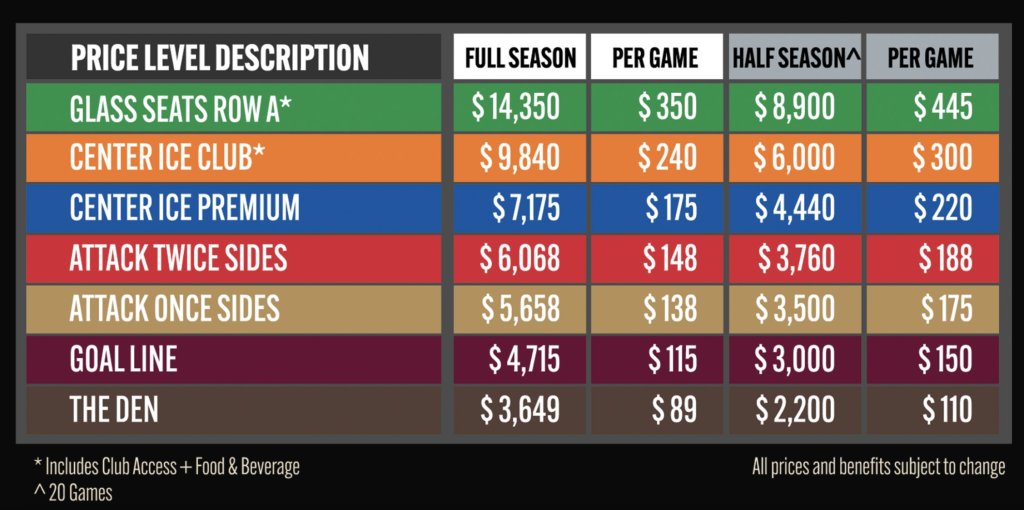
The newly advertised prices at ASU that were in an article on TicketNews.com appeared to be a breakdown for season tickets. The highest price is $350 ($14,350 for season) for a front row-glass. The lowest price is $89 ($3,649).

While $350 doesn’t sound that much higher than the previous $290, $89 is nearly FIVE times as much as the $18 cheap seats. And while those prices might sound reasonable for a contending team, the Coyotes are far from a contender.

The Coyotes finished the season 25-50-7. There doesn’t seem to be any reason to believe next season will be better. Their highest goal scorer is Clayton Keller, with the only other well-known players being Phil Kessel and Shayne Gostisbehere. Defenseman Jakob Chychrun, a 2016 first-round pick, was rumored to be up for trade all last season until he suffered an injury, and many think he might be traded during the draft. The Coyotes goaltending has been lackluster too, with Karel Vejmelka’s .898 and Harri Sateri’s .866 save percentages. (Those were the two goalies they chose to finish with, the others with better stats were traded, given away, or sent to the minors.) This just doesn’t sound like a team worthy of the new ticket prices, no matter how “intimate” the setting is.

It will be interesting to see if the Coyotes make any moves in the off-season to encourage fans to pony up the dough, or if they fall flat in any attempts to improve their team. It will also be interesting to see if they can fill the 5,000 seat ASU arena given those prices and the fact that they averaged 11,601 in *announced* attendance this past season at Gila River.

I think the Coyotes are going to have to do something better for the fans as this arena scenario will be in place at least through the 2024-2025 season. That’s at least three seasons, possibly four seasons of playing in an “intimate” venue and possibly losing more money. (Not even mentioning the money they are looking into investing in a long-term new facility.) Let’s remember, this is a team that was having trouble paying players’ salaries at the end of the 2020-2021 season and problems paying debts to Gila River Arena until they threatened to lock them out, so if they don’t stop the bleeding soon how long are they going to be able to stay afloat in the desert?

Jokes and Soaps

I know I promised my next blog would be the second part of KC Back in the NHL?, but things currently going on in the NHL sidetracked me so much I’m writing today’s short blog. I could be writing about Matthews hitting 60, but it hasn’t happened, yet. It’s currently 7:56pm Central Time April 26, 2022, as I am writing.

Instead, I am choosing to write about NHL jokes.

Most fans are aware the Arizona Coyotes could currently hold the title of NHL joke champion with everything they have done and been through in their quarter of a century in the desert. Quarter of a century, I hear you shout at the screen. Yep, the Coyotes have been in Arizona for 25 years now.

I could run through the litany of things that make them a joke, but right now the one that sticks out is that they don’t have an NHL quality facility to play in next season. The thing that kills me is the team and league seem content to play in a college arena that seats less than most ECHL arenas and they’re still probably 4-5 years from having an NHL quality facility built, and that’s only assuming they’re able to get a deal done on land they’d like to build on and can push it through regulations the city and/or state would have for them.

Speaking of Arizona…Auston Matthews just did it. Sixty goals for the kid who grew up watching the Coyotes. It’s 8:03pm CT by my clock.

Anyways, there’s another joke going around the NHL. It’s the impending disaster the Vegas Knights seem destine to experience. While the Knights currently lead the Stars 1-0, 31 teams in the NHL are hoping they lose and miss qualifying for the playoffs the first time in their history.

Ok, joke may not be the right word. How about soap opera? That’s what this season has turned into. In fact, last week during the Real Kyper and Bourne Sportsnet radio show/podcast, Nick Kypreos had the producer play the theme from Days of Our Lives in reference to the Knights. From the team’s treatment and trading away of Fleury to their abuse of LTIR to circumvent the cap to making a fraudulent trade (quit blaming Ottawa, pretty sure you had a copy of Dadonov’s contract…heck one website had the list of his no trade clause teams) to their demand and need of using injured players (Stone and Lehner) to DeBoer throwing Lehner under the bus. It’s been a soap opera.

And while the Yotes are the joke, and the Knights the soap. I can’t help but wonder why a player would want to play for either team? The Coyotes stink and will play to pathetic crowds for the foreseeable future. Why would you want to go to them? And Vegas continually turns over their roster and shows no loyalty to even a player that was the cornerstone, the guy who won the Vezina just last year. Why would you want to play for a team that doesn’t keep their promise to their best player? A promise that came directly from the owner’s mouth that you would retire with his team, and then a few months later the team trades you away for nothing. And while the Knights have done this in their pursuit of the Cup, what do they have to show for it? Hopefully, a change in the way they do business. Meanwhile, 30 other teams might be celebrating right along with the Stars if/when they win tonight.

KC Back in the NHL? Not anytime soon…

Over the years I’ve heard folks say KC should have an NHL team. While I’d support an NHL team the best I could, I can’t see why anyone would think Kansas City could support one…now.

There are people who believe that because KC was home to the NHL Scouts from 1974-76 the city should automatically be considered for a franchise. They obviously don’t realize the disaster the two-year run of the team that’d eventually become the New Jersey Devils (after moving twice) was. Anyone interested in the story should check out the book Icing on the Plains: The Rough Ride of Kansas City’s NHL Scouts by Troy Treasure. Treasure’s book demonstrates how KC’s first foray into the NHL was a disaster at the box office and on the ice. It is a great read for hockey fans, but an even better read for KC sports fans.

Between the two seasons, the Scouts average attendance was less than 8,000. Looking at average attendance for NHL teams that doesn’t come close to the lowest average of 12,442 the Islanders had during the pre-pandemic 2018-19 season. [ESPN.com] It does slightly come above the Senators 2021-22 current average of 7,551, but that attendance figure is skewed because of pandemic restrictions the province of Ontario had in place for part of the season. (Ottawa played games without fans, or with reduced capacity) So for those using the “KC had an NHL team” argument, I would say KC would still need to prove it could support a team. And, those two years in the 70s didn’t do it.

Another argument against KC getting a franchise now would be the NHL appears to be done with expansion. The league is at a nice round number of 32 teams, and now each division and conference have an equal number of teams.

Your next question for me is what about relocation, right? Commissioner Bettman seems determined to not have any more teams relocate. So much so that it isn’t a problem the Coyotes don’t have an NHL quality facility to play in for the foreseeable future. He has said the league will exhaust every possibility before they would consider relocation. One would assume that would be the case before the league would consider moving any franchise if that is how they feel about the often troubled, many times joked about Coyotes.

Now, even if things were to change with expansion or relocation, there are factors that just don’t make the NHL in KC sit right with me currently. One of those is ticket prices. The most recent single game ticket prices I could find for NHL teams was from 2015-16, when there were 30 teams. 18 teams had an average ticket price of just under $100. Now, think about trying to fill T-Mobile Center 41 days and/or nights a year with prices comparable to that. While you’re thinking about that, also remember the KC Mavericks are currently not packing Cable Dahmer Arena the way they used to, and their highest single game ticket price is a little over half of that NHL price. (Hockeydb.com has Mavericks average attendance for 2021-22 season at 2,862, as of March 19, 2022)

I realize comparing the Mavericks ECHL numbers with NHL numbers is like comparing apples to oranges, but I’m not trying to compare the numbers. I am trying to show how the current appetite for hockey seems to be in Kansas City.

Now, for numbers that can reasonably be compared, let’s look at attendance figures I’ve been able to find for NHL exhibition games held at Sprint Center (now T-Mobile Center). First off, T-Mobile Center has a 17,000+ capacity for hockey games. The first game in 2008 between the Kings and Blues had 11,603. The second in 2009 between the Islanders and Kings had 9,792. The third game in 2011 was the first sell-out with 17,779 to see the Penguins and Kings (that includes 235 standing room only tickets). In 2016, the fifth game between the Washington Capitals and Blues drew 12,500. I wasn’t able to find figures for the Stars and Blues in 2014 or the Wild and Blues in 2017. So, two of those four games I could find numbers for cracked that bottom 2018-19 Islanders bottom attendance number of 12,442. So, those attendance numbers that KC put up were good, they certainly aren’t anything that would I think would be super-impressive to the NHL or any potential owners.

Speaking of potential owners, I haven’t heard of any potential owners or ownership teams for an NHL expansion franchise in Kansas City.

So, while Kansas City has the building for the team, I just don’t see the interest an NHL team would need to be successful…for now.

And the most important thing that I want everyone to take away from all I have written, isn’t the numbers or the fact I can’t see the NHL working in KC. The most important thing I want you to take away is the word “now”. The reason I say that is I’m optimistic about the future for the NHL and Kansas City, and I have ideas about what those who share my optimism and a passion for hockey in KC could do to help maybe make an NHL team in KC part of the city’s sports future. In my next blog, I will talk about some of the things that would need to be done to improve KC in the eyes of the NHL and any potential owner. I also talk about why I think the next new NHL city (whether it’s Quebec, Houston, or KC) will be taking on a team from another city.